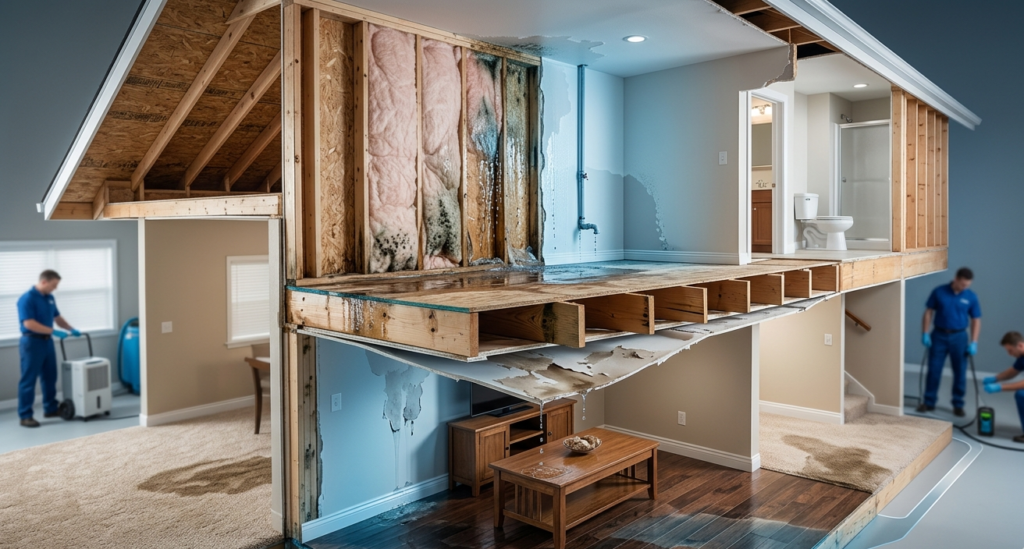
Most people see water damage and think the problem is only where the water is. That’s the mistake. Water moves – through drywall, under flooring, behind baseboards, inside insulation – and by the time you see the damage on the surface, it’s already spread much further than you realize.
Understanding how water travels through your home is the difference between a quick fix and a full gut renovation.
How Water Gets In
Water damage rarely starts with a flood. Most of the time it begins small:
- A slow pipe leak behind the wall
- A roof leak that drips into the attic
- A window seal that failed months ago
- An appliance line that’s been weeping for weeks
- Rainwater pooling against the foundation
The sneaky part is that small, slow leaks cause just as much structural damage as sudden flooding – sometimes more, because they go unnoticed for longer.
How Water Spreads Through Walls
Once moisture gets inside a wall cavity, it moves fast and in every direction.
Drywall is extremely absorbent. It wicks moisture upward through capillary action – the same way a paper towel soaks up a spill. A leak at the base of a wall can travel 12 to 18 inches upward in just a few hours.

Inside the wall, moisture then reaches:
Insulation – Fiberglass batts hold water and don’t dry on their own. Foam insulation can trap moisture against the wood framing behind it. Wet insulation loses all thermal value and becomes a mold incubator. Professional insulation removal drying is often necessary once insulation has been saturated.
Wood framing and studs – Wood absorbs water quickly. Once framing gets wet, it begins to swell and warp. Left wet long enough, wood rot sets in and structural integrity is compromised.
Electrical wiring – Water in walls that reaches wiring is a serious fire and safety hazard. This is one situation where you need a professional immediately.
Vapor barrier – In properly built walls, a vapor barrier slows moisture movement. But once breached, moisture gets trapped between the barrier and the framing, creating ideal mold conditions.
How Water Spreads Through Floors
Flooring is where water damage gets expensive fast.
Hardwood floors – Wood expands when wet. Within hours of water exposure, hardwood planks begin to cup or crown. Once this happens, the boards have absorbed enough moisture to potentially require full replacement. Our hardwood floor salvage team can assess whether boards can be saved or need replacing.
Laminate and engineered wood – These materials swell when wet and rarely
recover. The core layer absorbs water rapidly and breaks down the adhesive
holding the layers together.
Tile floors – Tile itself is waterproof, but the grout and the subfloor beneath it are not. Water seeps through grout lines and saturates the concrete board or plywood subfloor below. You can have a perfectly intact tile floor sitting on top of a completely soaked and rotting subfloor.
Carpet and padding – Carpet padding acts like a sponge. It holds enormous amounts of moisture while the carpet surface above feels only slightly damp. This is one of the fastest environments for mold growth in a home.
Subfloor – Once the subfloor gets wet, the problem goes structural. A compromised subfloor means your finished flooring has nothing solid to sit on. This is where structural drying solutions become essential.
The Mold Timeline You Need to Know
Here is where water damage becomes a health issue, not just a structural one.
24 hours – Mold spores that are naturally present in any home environment begin activating in moist conditions.
24 to 48 hours – Mold colonies begin to form on wet drywall, wood, and
insulation.
3 to 7 days – Visible mold growth appears on surfaces. At this point, remediation is significantly more involved and expensive.
Beyond 7 days – Mold has likely spread into wall cavities and HVAC systems,
requiring professional mold remediation experts and potentially making areas of the home temporarily uninhabitable.

The U.S. Environmental Protection Agency (EPA) provides clear guidance on mold prevention and cleanup for homeowners at epa.gov – including when professional remediation is required versus what you can handle yourself.
Warning Signs Water Has Already Spread
Do not wait for visible water to take action. Look for these signs:
On walls:
- Bubbling or peeling paint
- Soft spots when you press lightly
- Yellow, brown, or rust-colored stains
- Visible mold or black spotting at baseboards
- Musty smell with no obvious source
On floors:
- Hardwood cupping, crowning, or buckling
- Soft or spongy spots underfoot
- Tile that sounds hollow when tapped
- Grout that is cracking or missing in areas near plumbing
- Carpet that stays damp longer than 24 hours after a spill
On ceilings:
- Sagging or bowing
- Water stains that keep expanding
- Paint that is bubbling or flaking
If you are seeing more than one of these signs, water has already moved beyond
the surface and into the structure of your home.
How to Stop Water From Spreading
Step 1 – Stop the source
No drying effort works while water is still entering. Find the source and
shut it off. Main water valve, appliance valve, roof tarp – whatever it takes.
If you cannot stop the source yourself, call our emergency water removal
Step 2 – Remove standing water immediately
Every hour of standing water increases how deep moisture penetrates into flooring and wall materials. Use a wet/dry vacuum, mop, or call a professional water extraction services
Step 3 – Pull up carpet and padding
Do not leave wet carpet sitting on subfloor. Pull it back, remove the padding, and get air circulating to the subfloor surface as fast as possible.
Step 4 – Open the walls if necessary
If you know or suspect water is inside the wall cavity, cutting inspection holes at the base of drywall panels allows air to circulate inside and dramatically speeds up drying. This feels drastic but prevents far worse damage.
Step 5 – Run dehumidifiers and fans aggressively
Industrial dehumidifiers pull far more moisture from the air than household units. Air movers directed at wet surfaces speed evaporation significantly. The goal is to get the affected area to normal moisture levels within 24 to 48 hours.
Step 6 – Check moisture levels with a meter
A moisture meter (available at hardware stores) lets you track whether drying is actually working. Walls and floors should return to below 16 percent moisture content to be considered dry.
When You Need a Professional
Some water damage situations are genuinely beyond DIY. Call a professional
restoration company if:
- Water has been sitting for more than 24 hours
- The affected area covers more than one room
- You see or smell mold already
- Water has reached electrical systems
- Sewage or contaminated water is involved
- Flooring or walls feel structurally compromised
For homeowners across the Houston area dealing with water intrusion, burst pipes, or storm damage, Water Damage Restoration Houston provides 24/7 emergency response – from immediate extraction through full structural drying and restoration. Catching it early is always the difference between a
manageable repair and a major renovation.
And if you are in Arkansas dealing with water damage that has already spread into your walls or floors, the team at Little Rock AR Water Damage specializes in exactly this kind of structural moisture damage – with fast response and the professional drying equipment needed to stop spread before it becomes
a full remediation job.
The Bottom Line
Water does not stay where you see it. It travels upward through drywall, downward through subfloors, and sideways through insulation – all while staying hidden behind finished surfaces.
The faster you act, the less it spreads. The less it spreads, the less it costs. That is the only rule that matters when water gets into your home.
Document it. Stop it. Dry it. And call a professional if it has already moved beyond the surface.
Frequently Asked Questions
How fast does water damage spread through walls?
Water can wick upward through drywall 12 to 18 inches within just a few hours. The spread depends on the material, the amount of water, and how long it has been sitting.
Can walls dry out on their own after water damage?
In very minor cases with excellent ventilation, possibly. But in most cases walls trap moisture inside and do not dry without fans, dehumidifiers, or inspection holes to allow airflow into the cavity.
How do I know if water is inside my walls?
Soft spots, bubbling paint, discoloration, musty smell, and mold at the baseboards are all signs. A moisture meter pressed against the drywall surface can also detect elevated moisture inside the wall.
Does homeowners insurance cover water damage that spread through walls?
It depends on the cause. Sudden and accidental damage is typically covered. Damage from a slow leak that went undetected for a long time is often not covered because insurers consider it a maintenance issue. Check your policy.
How long does it take to dry out walls after water damage?
With professional drying and dehumidification equipment, most walls can be dried to acceptable moisture levels in 3 to 5 days. Without equipment, it can take weeks – and mold will likely develop in the meantime.
Leave a Reply